The breaking news from Barcombe Nurseries is that there are newts in our pond! Cue a toot of the biodiversity horn! They’re 'smooth' newts to be precise, and whilst not the larger, greater-crested and legally protected kind, the discovery of these leopard spotted amphibians is a great sign that the acres under our care are getting wilder and wilder. Whilst our land has been farmed organically since 1997, it obviously has a history prior to that and we’re always trying to make things better, enriching the area in the true sense of the word i.e building healthy, living, nutrient dense soil and welcoming all the life that it sustains.
If you haven’t visited before, to be clear, we’re not talking about a little garden puddle here, the pond is a miniature lake really, and large enough to;
a). swim in without the slightest chance of touching the bottom
b). row a boat around (maybe even sail, if your tacking and gybing is up to tight turns)
c). use to irrigate our crops (a more pressing motivation than the prior examples, so much so in fact that digging a second one may well be in the works...)
d). support a growing menagerie of different species. At this point, before the decade is up we’re expecting fresh water turtles, pike, eels, beavers, otters and cranes to arrive. Knepp Estate eat your heart out.
Harry’s latest soundscape is back underwater with the whirligig and screech beetles,
it also features the swallows who nest each summer in our pack shed rafters.
(How’s that for a work perk when we’re catching up on admin?)
Warning: their chirping might send any nearby cats into a frenzy!
Listen here
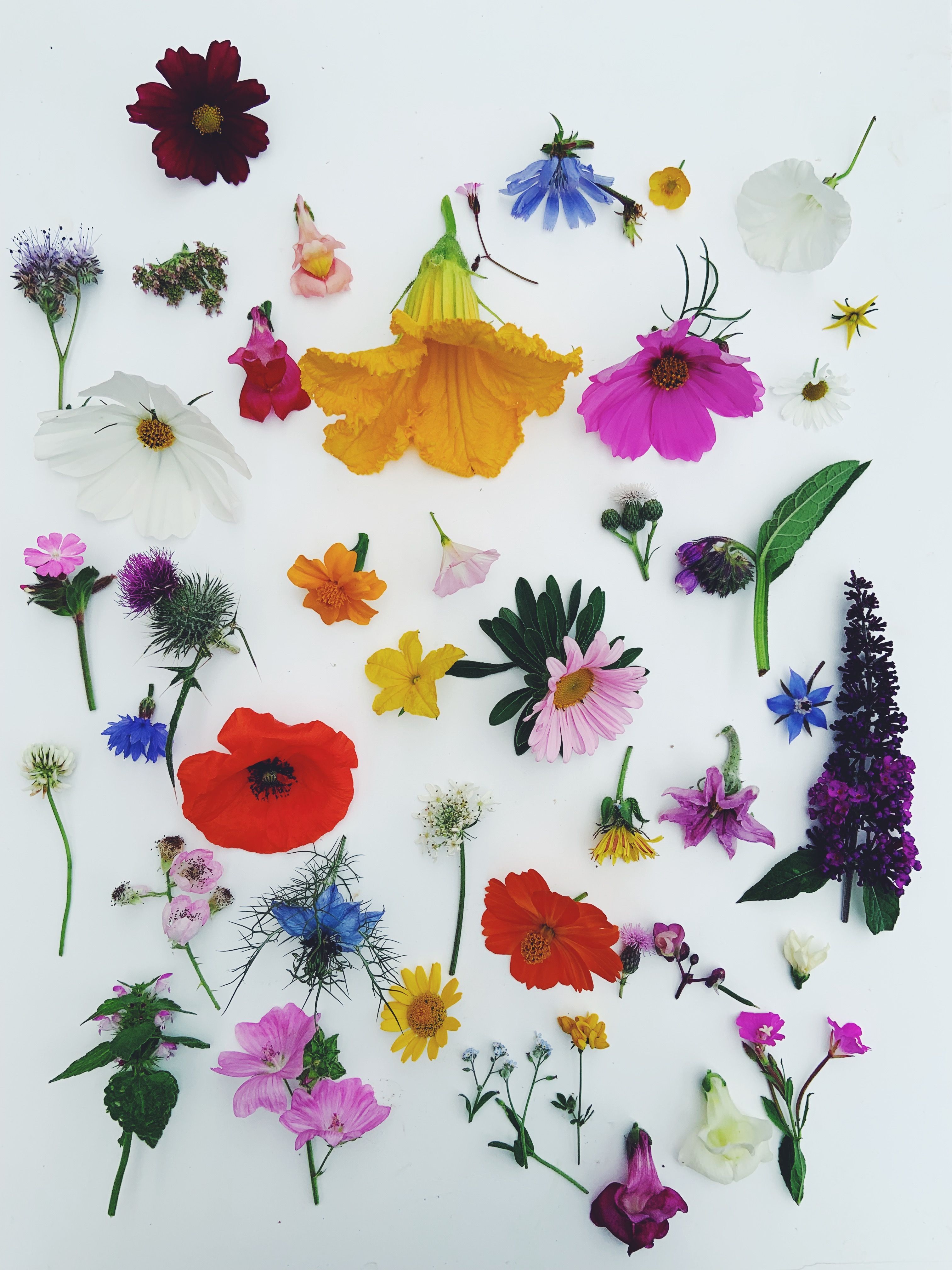
Another thing that’s making this summer stand out amongst all the others (some of us have only seen twenty one in total, others over sixty and over twenty one of those largely on the farm!) is… FLOWERS. This year we sowed and planted snapdragons, cosmos, sunflowers, asters, nigellas, corn cockles, borage and more. These are currently in full bloom at the ends of many of our veg beds as well as in a thick strip between the courgettes and leeks in our top field.
We decided to carve out the time in our schedule for these non-edibles, not only to benefit insects but also because, well, they look really lovely. We will always be focused on producing FOOD here, but this success has got us thinking about potentially offering some farm bunches in the future. We know the global cut-flower industry isn’t very pretty at all, but are inspired by UK florists who grow as well as arrange their bouquets. Let us know if you’d be interested in picking up a fistful of fancy narcissi or some squeaky-stemmed tulips or whether you reckon we should just stick to posies of purple sprouting broccoli and kale…
Speaking of leafy greens, at this time of year our chard, spinach and lettuce are all outdoors, (they’d practically cook undercover, even well-irrigated employees get pretty wilty if they’re in the glasshouses for hours during a scorcher!). This frees up space for green manures. No these aren’t lime, pea or mint coloured livestock byproducts that we buy in, they are plants we grow, not to harvest, but to suppress weeds, protect the soil from erosion and build fertility. We’ve been using a mixture of buckwheat, fava (or ‘field’ beans) and phacelia which we’ll incorporate back into the earth and leave to decompose. Each of this trio play a different role;
- Buckwheat isn’t a wheat at all, it’s a relative of rhubarb and sorrel and if you’ve only seen it in flour form, its seeds are triangular. Perhaps you have toasted them to add to salads or cooked them liked rice for some Eastern European kasha? Buckwheat is one of the quickest growing green manure crops, meaning it produces a large amount of nourishing matter before we have to mow it in so new crops can get established ahead of coming temperature drops. (The radicchios which will bring bright, bitter crunch to the colder months are currently in our propagation house preparing themselves to unfurl an amazing array of Barbie-pink or speckly leaves).
- Fava beans are wonderful for making the nitrogen which all plants require readily available, they do this by partnering with a bacteria called rhizobia, which can convert atmospheric nitrogen into organic forms. You can actually see evidence of this amazing chemical process in visible bobbles (or nodules) that form on the roots. The fava bean tops are also super tasty in our salad mix so look forward to finding them in your bags in a couple of weeks.
- Finally, phacelia has one of the top twenty honey-producing flowers as well as being attractive to hoverflies (and hoverflies eat aphids!). It also has an extensive root system which improves soil structure and dense foliage to crowd out any lurking nettles or other cheeky interlopers.
We’ve also been experimenting with ‘undersowing’ which is a similar idea to green manures but done alongside crops not instead of them. It can be implemented everywhere from full-scale fields of cereals to smaller areas where you might utilise polypropylene sheeting, which we made the decision to stop using due to micro-plastics, as a suppressant. Our aubergines, for example, currently have a lush carpet of trefoil and clover underneath them so that when you look down from above the scene is reminiscent of a forest floor and canopy of trees. We scatter all these seeds by hand, and while nowadays the word ‘broadcasting’ is more likely to bring television or radio to mind, that is of course its original meaning and it’s an activity we all enjoy. There’s something affirming about pacing up and down flicking out tiny, shiny, hard-cased things from which newness will spring. The pace and gesture can’t have changed since the first humans did it, and none of us need to forensically trace back our family trees to twig our ancestors were all land workers at some point. In modernity it’s quite unusual to tend to veg as a vocation, rather than a hastily squeezed in hobby, indeed when we visited a local primary school recently not a single pupil wanted to be a grower when they grow up, prompting us to ask who is going to feed all the footballers and singers? Farming is not presented as an attractive or respected career. We don’t all need to be fully self-sufficient to create a resilient, fair food system though, and we’re here to help you bridge the gap between contemporary existence and eating (and living) in tune with nature.
On that note, at this point in the annual cycle, late summer, it feels a smidgeon less frantic than the beginning. Our big field-scale plantings are all in the ground and it’s a pleasure to see the world around us maturing and mellowing. The neighbouring farm's fields are filling with hale bales like curls of butter and there’s a wild plum in a overlooked corner that we’ve been meaning to drag a ladder up to and inspect…
We hope you’ve been doing whatever you look forward to doing in the summer holidays; whether festival-going or trading in local pebbles for somewhere with enough sand to build castles.


© 2026 - Barcombe Nurseries
Powered by
